
 EN
EN
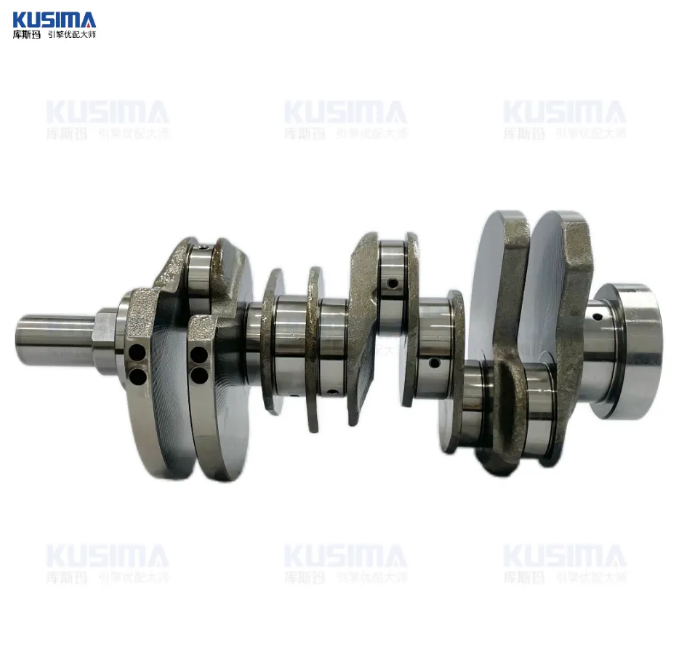
What Makes a Crankshaft More Than Just a Bent Piece of Steel
The crankshaft takes the pounding from each cylinder's combustion event and turns it into rotational motion that eventually moves the vehicle down the road. It's the single most heavily loaded rotating component in any passenger car engine. And yet, most drivers never think about it — until something goes wrong. When a crankshaft fails, it's rarely a subtle event. The engine locks up, connecting rods exit through the block, and the repair bill often exceeds the vehicle's value.
But not all crankshafts are created equal. The difference between a crankshaft that delivers smooth, vibration-free power for 200,000 miles and one that develops fatigue cracks at 80,000 miles comes down to material selection, forging versus casting, and the precision of the machining and balancing processes.
Forged vs. Cast — The Gap Is Wider Than Most People Realize
The metallurgical debate around crankshaft manufacturing has been settled for years, but the aftermarket still offers both options at different price points. Cast iron crankshafts are cheaper to produce. Molten iron pours into a mold, cools, and comes out in near-net shape. Minimal machining gets it to final dimensions. For low-output engines operating within modest RPM ranges, cast crankshafts work fine.
Forged steel crankshafts tell a different story. A billet of alloy steel gets heated and hammered under immense pressure, aligning the grain structure along the contours of the crank throws and journals. This grain flow follows the load paths, creating a component that resists bending and fatigue far better than any casting. Research from the University of Toledo demonstrated that forged-steel crankshafts have 36% higher fatigue strength than cast-iron crankshafts. That translates into a service life roughly six times longer for the forged product under equivalent loading conditions.
| Characteristic | Forged Steel | Cast Iron |
|---|---|---|
| Fatigue strength | 36% higher | Baseline |
| Service life under equivalent load | ~6x longer | Baseline |
| Grain structure | Aligned with load paths | Random, isotropic |
| Cost | Higher | Lower |
| Suitability | High-output, high-RPM engines | Low-to-moderate output engines |
The cost difference exists for a reason. For engines that see sustained high RPM, forced induction, or heavy towing duty, forged steel isn't a luxury — it's a necessity.
Material Grade Matters Just as Much as the Manufacturing Process
Even within forged steel crankshafts, material selection varies significantly. Common alloys include 40CrNiMoA, 34CrNi3MoA, and similar chromium-nickel-molybdenum steels. These alloys offer the right balance of hardenability, toughness, and fatigue resistance for automotive crankshaft applications. The chromium provides hardenability and wear resistance. Nickel improves toughness and impact strength. Molybdenum adds high-temperature strength and further enhances hardenability.
The heat treatment regimen matters just as much. Quenching and tempering schedules determine the final microstructure — and therefore the mechanical properties. A properly heat-treated forged steel crankshaft achieves a fine-grained tempered martensite structure that delivers both high tensile strength and adequate ductility to absorb shock loads without fracturing.
Balancing — The Difference Between Smooth and Shaky
A crankshaft that's out of balance transmits vibration through the entire rotating assembly. Main bearings wear unevenly. The front accessory drive experiences cyclic loading that shortens belt life. And the driver feels it as an uncomfortable buzz through the steering wheel and seat at certain RPM ranges.
Precision balancing involves removing material from specific counterweights to cancel out the rotational and reciprocating forces generated by the pistons and connecting rods. Factory crankshafts receive this treatment, but aftermarket replacements sometimes skip the final balancing step to save cost. An unbalanced crankshaft may still "work," but the long-term effects on bearing life and overall engine smoothness are undeniable. A dynamically balanced crankshaft — balanced both statically and at operating speed — eliminates these vibration modes entirely.
Machining Tolerances — Where Microns Make the Difference
The bearing journals on a crankshaft must be round, straight, and sized within tight tolerances. Most passenger car crankshafts specify main and rod journal diameters within ±0.0005 inches of nominal. Surface finish matters too. A rougher journal surface accelerates bearing wear by creating localized high spots that break through the oil film.
Quality manufacturers use CNC grinding equipment capable of holding these tolerances consistently. They also apply micro-polishing to the journals to achieve the specified surface finish — typically 8 to 12 microinches Ra. Anything rougher invites premature bearing failure. Anything smoother offers diminishing returns at increased cost. The right balance comes from years of production experience and rigorous quality control.
Real-World Proof — A Fleet Operator's Experience
A regional delivery fleet operating 120 vehicles across the Midwest ran into a pattern of crankshaft failures on one particular engine platform. The vehicles averaged 4,500 miles per month, mostly highway miles with occasional stop-and-go city driving. The original equipment cast crankshafts were failing at an average of 85,000 miles — well below the expected service life.
The fleet switched to forged steel crankshafts from a specialist supplier on the next round of engine rebuilds. That decision eliminated crankshaft-related failures entirely over the next 300,000 miles of fleet operation. The fleet manager calculated the total cost of ownership reduction — factoring in tow trucks, rental vehicles, lost revenue from downtime, and labor for teardowns — and found the higher upfront cost of the forged crankshaft paid for itself within the first 18 months. The vehicles are still running those same crankshafts today.
The Long Game — Why Upfront Quality Pays Off
Every crankshaft has a finite fatigue life. The number of stress cycles it can withstand before crack initiation depends on material, manufacturing process, and operating conditions. A cast crankshaft might survive 10 million cycles at moderate loads. A forged steel crankshaft under the same conditions might survive 60 million cycles — enough to outlast the rest of the engine by a wide margin.
For passenger car owners who plan to keep their vehicles beyond 100,000 miles, the choice becomes obvious. The incremental cost of a forged steel crankshaft over a cast alternative is modest compared to the cost of an engine replacement. For repair shops and engine builders, specifying forged steel crankshafts reduces warranty claims and builds a reputation for durability.
Haodun Engine Parts manufactures forged steel crankshafts using high-grade alloy materials like 40CrNiMoA, with precision CNC machining, dynamic balancing, and rigorous quality testing to meet OE specifications. The grain structure follows the load paths, the journals are ground to exacting tolerances, and every unit undergoes inspection before leaving the factory — delivering the durability that high-mileage and high-performance applications demand.
Table of Contents
- What Makes a Crankshaft More Than Just a Bent Piece of Steel
- Forged vs. Cast — The Gap Is Wider Than Most People Realize
- Material Grade Matters Just as Much as the Manufacturing Process
- Balancing — The Difference Between Smooth and Shaky
- Machining Tolerances — Where Microns Make the Difference
- Real-World Proof — A Fleet Operator's Experience
- The Long Game — Why Upfront Quality Pays Off